The rest of the story...

Here's where I tell you all the stuff that wouldn't fit in a 2-minute TV story.

Tuesday, November 20, 2012

Whatever Happened to Touchdown Tommy?


"I was having a nervous breakdown on national television and no one could see it."
-- Tommy Edwards in our interview for John Carlin's Virginia.


We interviewed on his front porch in Roanoke.
Tommy Edward's story is an intricate one.  We all live complicated lives, but few among us have lived so close to the edge as Touchdown Tommy.

Let me explain what I mean by "edge."  There's an edge we think of as the "cliff."  Right now the entire nation is watching the president and congress to see if we can avoid going over the fiscal cliff.  That would be bad.

Tommy has certainly gone over the cliff several times in his life as he has battled mental illness, drugs and alcohol.  But there's another "edge" as well.  And that edge is only seen by folks who have talent beyond everyday people.  Tommy's talents have taken him to places most people could never achieve.  His edges are often as close to greatness as they are calamity.

Tommy does a hand plant.
Not only is he a celebrated football player, he is also an artist and musician who has played with some big time names.  He is an entrepreneur who has started companies and foundations. 

Tommy has seen higher highs and lower lows than 99-percent of us.  He's led the league in rushing.  He's created his own skateboard company.  He's recorded multiple CD's from his part-time home in Nashville.  But he's also suffered from too many bangs to the head (from football and skateboard accidents).  He suffers from mental illness that has not always been under control.  He's been homeless.

This is a tough story to tell in a TV news segment.  Tommy's story really deserves treatment in a longer form  -- a documentary, reality TV segment or a book.

In tv news we interview our subjects, do some research, take some video and put it on the news.  Tommy's doesn't fit very well in that format.  There's just too much.

Tommy keeping life "in balance"
What you DO get from a tv story, however is a measure of the person, just by watching the interview clips that make air.  You get a certain sense of the person that can't be described by the written word or still photos. In Tommy's case you will also see him balancing on a roller board, playing guitar and singing a song he wrote.  Life on the edge.  Or with the roller board, as Tommy puts it, "Life in balance."

And now, with the internet, I can share additional information about Tommy's talents by providing you with links to his Heart of Virginia Foundation, or his music.  Click here for a You Tube Video that shows some of his football prowess and ends with his musical talents.

As I write this, Tommy seems to be near new levels of achievement in two aspects of his multifaceted life.  His music, which is getting more and more attention, and his advocacy for help for people with mental illness -- specifically with respect to the mass shootings that dominate the headlines.  Tommy avers that society needs to recognize, embrace and help the people who suffer from treatable disorders or we will continue to suffer at the hands of deranged individuals who somehow believe that killing others is the solution to their problems.

He's sharing the dark side of his story as a call to action.

The hook for the TV story was pretty simple: Whatever happened to Touchdown Tommy?  What happened to the kid who seemed like a lock for the NFL even when he was at Radford High School? The tv story answers those questions, but who knows where the complicated story of his life will go next?  One day the world may look at the body of his work and say, " Wow, he was also a pretty good football player."


Tuesday, November 6, 2012

Cat Trappers

Darcie Luster with trapped kittens.
Click here to view the Television Story that aired on Fox 21/27.

When you talk about feral cats, you begin to get frustrated.

Your reasoning goes something like this:  Cats are pets.  People should take care of their pets.  If people would just do what they are supposed to do there would be no such thing as "wild" house cats.  Can't we just go catch them all, tame them and see that they get good homes?

Another, less sympathetic line of reasoning might be:  If these "wild" house cats are causing such a problem, let's catch them and have them euthanized so they can't cause any more problems.

Neither solution will work.

That's what I learned when I spent a day last summer with Darcie Luster, a cat trapper in Floyd County.

According to Darcie, there will always be feral cats.  The best we can hope to do is manage them.  People will always drop off unwanted litters near barns, dumpsters or the side of the road.  Those kittens will create populations that will sustain themselves, unless there is human intervention.

I initially had a hard time understanding the intervention part.

Darcie traps the cats, takes them to the Mountainview Humane Spay/Neuter Clinic in Christinansburg where they are "fixed," given a rabies shot and returned to Darcie who returns them to the wild.  (unless they are kittens young enough to be tamed and adopted.)

Why in the world would you return them to the wild?

Apparently, it actually keeps the numbers of feral cats in check.  The neutered cats still own that piece of territory.  They interact with other neutered cats in that zone and produce no kittens.  They also prevent other strays from taking up residence there.

Darcie says the case study in our TV segment proves it.  (As do many cases.)  The feral cat population has dwindled from about twenty down to five or six near the Floyd warehouse where we shot the segment.

I also asked her if she ever mistakenly trapped someone's pet.  She says it happens occasionally but real house cats act differently than their feral cousins.  "Feral cats don't meow," she explained.  "That's a learned behavior that comes from being around humans."  They also act differently after they've been trapped.  They are much calmer.  "If it happens, we just take them back to their home unharmed," she said.

All in all, Darcie and Kathy Poole, president of the Floyd County Humane Society make a strong case for TNR -- Trap, Neuter and Release.

They are dealing with dozens of colonies around the county.  They have garnered widespread support, and it seems to be working.


Tuesday, October 16, 2012

Tiny Houses

John puts the mic on Sarah McNair
Click here To view the TV Story that accompanies this blog.

When you look at Sarah McNair's master's thesis, sitting in her parent's back yard in Giles County only a few miles from Mountain Lake, you ask yourself, why?  Why would anyone want to live in a home that's only 150 square feet including bedroom, bathroom, kitchen and what Sarah jokingly calls the "great room."


At first you think, "This could be cool."  But then you realize it could be cool for a weekend, or maybe for a few weekends in summer or for an occasional getaway.  After all, that's why we have camping.

But Sarah has tapped into something that's a bit of a movement in the United States.  People are leaving behind all of their "stuff."  They are moving toward a less "impactful" way of living.    People are leaving it all behind, living with just what they need and nothing more.

Wikipedia's report on the small house movement credits Sarah Susanka with starting the movement in 1997, with her book entitled,  The Not So Big House.

A recent blog exclaims that Americans have too much stuff and that stuff, "doesn't necessarily lead to greater happiness."  

Sarah McNair mentioned all of that when she gave me a tour of the home she's been building this summer in her parents yard.  For her it is about sustainability, a smaller carbon footprint and living responsibly.  Sarah is working on her master's thesis at American Military University, which is open to both military and non-military students.  (Sarah is non-military.)

Her professors have allowed her to build this house in addition to the more traditional research paper she must write to earn her degree.  Instead of living in it, she will sell it.  Sarah says she believes int he movement, but this project is about research.

For instance she has learned that "green" building supplies can be expensive.  One of the virtues of small houses is that they are supposed to be inexpensive, "so people can live mortgage free."  Sarah did her part by purchasing a lot of the materials from used materials stores. The Habitat ReStore in Roanoke would be an example.  If people take old sinks and fixtures to the store and others buy them, then that stuff doesn't go to the landfill and the world's energy isn't wasted building new sinks and fixtures...

Now what was I going to say?
But there is a point of diminishing returns on the sustainability front.  Sarah figures she will have about $15,000 invested in her small house by the time it's done.  "I could have spent $50,000 if I went completely green," she told me.  That's not a bad lesson.

As much as I wanted to delve into the sustainable side of this story -- and I'm a huge advocate for sustainable living, I just couldn't get past the whole, how do you live in such a cramped space story?

So that's the focus of the TV report.  There was simple too much don't bump your head low-hanging fruit.  Where do you put your skis, aquriums, kitchen gadgets yada yada yada.  It was fun, and Sarah is a good sport.

At some level I agree that we have too much stuff.  Heck, the utility room in my basement is the same size as Sarah's house.  I'm pretty sure I couldn't even fit all the Carlin family Christmas decorations in her "home!"

So be it.  It's a cool project and it raises some good questions about the way American's live their lives.  If people want to down size, why not?


Tuesday, October 2, 2012

Big Spring Mill

Click here to view the story that aired on Fox 21/27.

I'm not sure what I expected to find at the Big Spring Mill in Elliston.

Bob Long
Bob Rotanz owner of Mac and Bob's restaurant in Salem and a fellow YMCA board member told me he used their flour in the restaurant and thought their story was a good one for my segment.

Not only is it the story of a mill that still does things the "old fashioned way"  -- that is one of the few family owned mills the the state -- and might be the only one, (I just didn't have time to check) but it represents a true family enterprise that's grown through generations of millers and their wives who tested the flour to ensure really fluffy biscuits and seasoning that creates amazing fried chicken.


Hand tied bags of flour
The finished product

This would be a better book than a TV news story... but I did the best I could in my allotted time.

The Long Family from the current owners Bob and his uncle, David to Bob's retired father Bill to the his parents and grand parents who set up shop in the same spot in 1937 -- it's a story of perseverance.


Standing there it's cool to see people coming and going to buy a bag of flour, or animal feed over the counter in the quaint business office at the mill.   It's amazing to watch workers deftly using twine to tie miller's knots on every sack of flour, and to hear stories of how the famous seasoned flour is mail-ordered from all over the world because nothing else tastes quite like it.

Yes.  This is the story of an old way of doing things through the generations, but it's also evidence that left alone, just off the beaten path in our generic world of big box stores and franchise restaurants Virginians continue to find success and happiness in a simple, rural lifestyle.


Monday, September 17, 2012

Snoflex Skiing in Summer -- in Lynchburg

Click here to view the story that aired on Fox 21/27.

I wasn't sure what to expect, but ever since the Liberty Mountain Snoflex Centre opened a few years ago in Lynchburg, I had been wanting to find out.

Liberty University President Jerry Falwell Jr. had been nice enough to give me a tour in 2009, just prior to the park's opening.  He had explained how the white AstroTurf-type material was designed just for skiing and that it was very popular in Europe.  All they had to do, explained, was to trickle water through a system that is not unlike a sprinkler system for your yard, and this stuff was ski-able.


So trusty videographer Curt Schruth and I headed out on the hottest day of the summer to find out if we could in fact, ski.

I grew up skiing in Vermont.  It's like second nature to me.  So I was both excited at the prospect of getting in some turns, and apprehensive because after all -- it just wasn't really snow.

All the gear is the same, skis, poles, bindings etc.  No shorts because if you wipe out, the rug burn is pretty bad. 

Out on the hill there were some guys doing amazing flips and tricks on their snowboards, so it had to be doable right?

Plus You Tube is full of videos like this one, showing exactly how awesome it is.

Well, not so much.  Not for me.  I didn't fall, and I was able to turn, but I was not able to link together long beautiful arcing turns (or even fun quick ones) like I can on snow.

To be fair, they say it takes a while and that long-time skiers often take a bit longer to get the hang of it, because they need to unlearn habits born on real snow.

And it doesn't matter what I think.  There are tons of people doing this and loving it.  The business seems to be growing and let's face it -- we we skiing in Lynchburg -- in July.


Tuesday, September 4, 2012

Bob Jenkins and the Roanoke River


I hope you’ve been enjoying the “best of” stories we’ve been presenting this summer. We’ve been traveling the region for two years now, bringing you stories from off the beaten path.   If there is another reporter on the story – it’s probably not the right fit for this segment! 

During the past couple months, videographer Curt Schruth and I have been busy shooting new stories.  And the first one airs tonight, September 4. -- jc

Dr. Bob Jenkins
Riverweed Darter

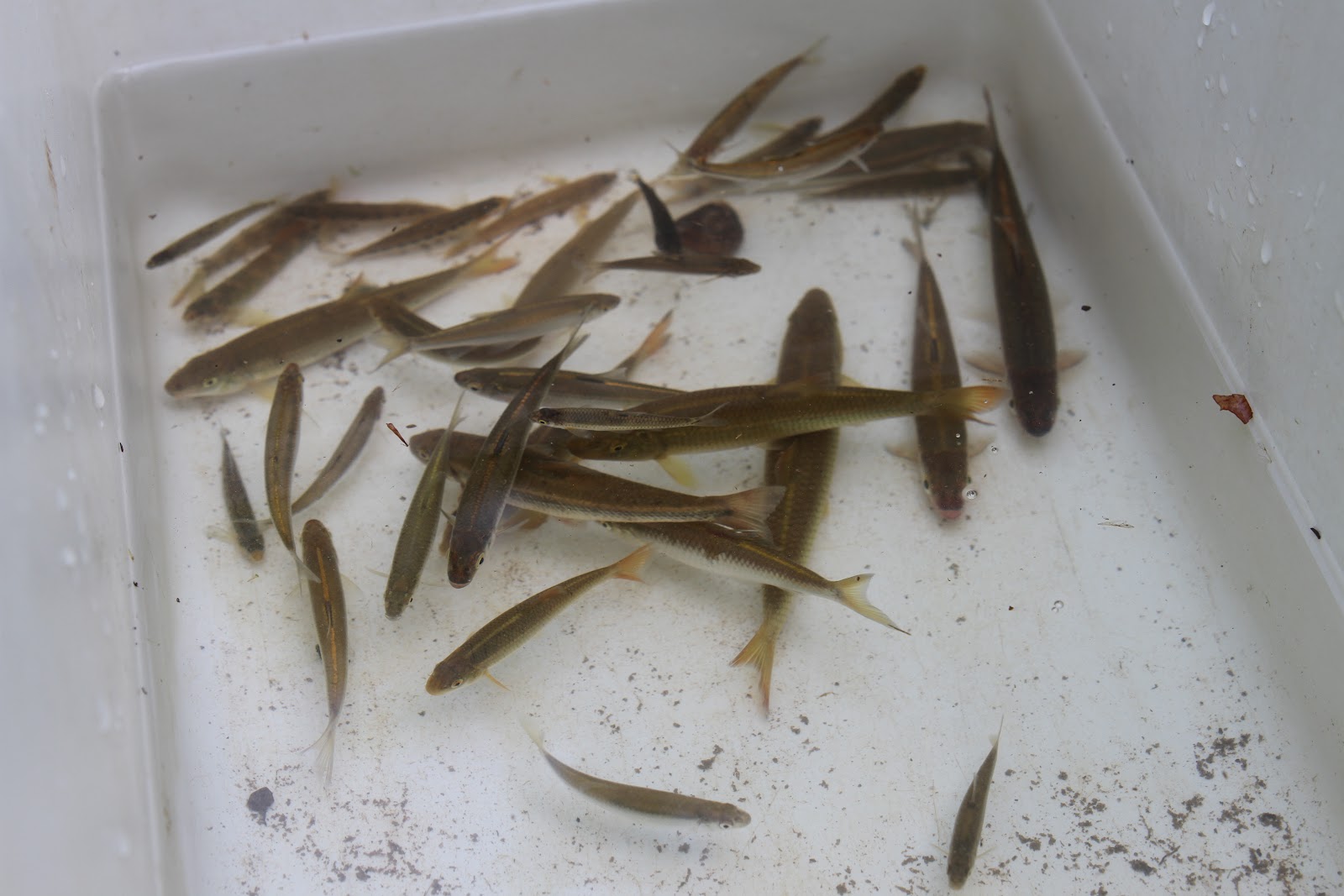
We did not see any other media on our recent outing on the Roanoke River where I hoped to accomplish two things – profile Bob Jenkins the man who wrote the book on the freshwater fishes of Virginia – and to show you video of what he’s written about – not the bass and sunfish you already know about, but the beautiful denizens of the river bottom most people have never seen nor heard of.

I’d say we did both. 

We met Jenkins and a team led by Dr. Steve Powers at Green Hill Park in Roanoke County. Jenkins had recently retired from RC and Powers is the person who picked up where Bob left off.  The group used large seins or nets to capture dozens of specimens, among them many darter species that are among the most beautiful fish in the river.

Roanoke Darter

Powers and the team chase small fish into the net.


We also talked about some of the other “keystone” species, like chubs, which build nests out of pebbles, that other species depend upon for reproduction. 

Fantail darter
Jenkins, a noted character who loves Pink Floyd (and other music once described as counter culture) as much as the river, was as colorful as advertised and had no trouble sharing a lifetime of river research on camera.  Don’t worry we edited out the parts where he was a bit too scientific!  (He is, after all, a scientist)

I admit it – I’m a fish geek.  I find this stuff fascinating.  I hope in this story you will see some reason for your own fascination.  Perhaps you will be – as many are – amazed at the number of and variety of fish that call the Roanoke River home.

Stonefly nymph
If nothing else – maybe you’ll look at the river that flows through the heart of our valley a little differently next time you cross over it in your car or while you’re  walking along the greenway. 

By the way – it’s in better shape than you might think and represents a great resource for all of us.


Thanks to Dr. Steve Powers for the photos of the darters.

Tuesday, May 15, 2012

After Jack

For the second segment in a row we have focused on talented local musical acts trying to accomplish the same thing as the American Idol contestants.  How hard is it to make it?

Fox Photographer Curt Schruth takes some video of After Jack.


Mary Allison
After Jack is an interesting band to say the least.  Three young women -- all talented actresses, musicians and vocalists who play a twangy, bluegrass or "roots" oriented sound that ranges from Lady Gaga to their own song, Bless Your Heart.

They play multiple instruments and harmonize beautifully.

All three live in the same old farmhouse out in the country.  What a hoot it was to record our segment as they practiced on their front porch.


Rachel Blankenship
In the previous segment I asked local rockers Madrone how hard they were willing to work to make it.  The four young men said they would work as hard as they could, but have no delusions about being the next Metallica.

I had hoped they would say they wouldn't quit till they had a wall full of gold records, but that wasn't their answer.

Ditto for After Jack.

"We work for the privilege to continue working," said Emily Rose Tucker.


"We work for the privilege to continue working."

In other words we hope to be good enough to get another gig.  And then another.  And another.

Like Madrone, the members of After Jack want to build a following, get better every performance and see "where it takes us."

You have to admire that.  Last night (May 14) I had the honor of speaking to Roanoke's B'nai B'rith award winners -- essentially the true who's who among Roanoke Valley High School seniors.

I shared with them the thought that they needed to figure out what they loved and where they excelled and to pursue that.  I asked them, "How many people who work in cubicles, 'work for the privilege to continue working?'"

Look, we all have to work for a living, and few people with responsibilities can pack up and hit the road chasing a dream.  But if you have the talent and the passion.  If you know that's who you are, why not?

Emily Rose Tucker, Rachel Blankenship and Mary Allison, whom I've seen perform in the Jack Tale Players and in musical productions at Ferrum College seem to me to have the presence and talent to entertain the masses.  They have only been After Jack for nine months.

After a lifetime of performing each said they felt a certain success with this band they had not felt before.

I hope one day we see them on the Grand Ole Opry or hear them on the radio or interview them when they make a gold record.

But for now, they are just hoping to be good enough to "keep on working."