The rest of the story...

Here's where I tell you all the stuff that wouldn't fit in a 2-minute TV story.

Monday, September 17, 2012

Snoflex Skiing in Summer -- in Lynchburg

Click here to view the story that aired on Fox 21/27.

I wasn't sure what to expect, but ever since the Liberty Mountain Snoflex Centre opened a few years ago in Lynchburg, I had been wanting to find out.

Liberty University President Jerry Falwell Jr. had been nice enough to give me a tour in 2009, just prior to the park's opening.  He had explained how the white AstroTurf-type material was designed just for skiing and that it was very popular in Europe.  All they had to do, explained, was to trickle water through a system that is not unlike a sprinkler system for your yard, and this stuff was ski-able.


So trusty videographer Curt Schruth and I headed out on the hottest day of the summer to find out if we could in fact, ski.

I grew up skiing in Vermont.  It's like second nature to me.  So I was both excited at the prospect of getting in some turns, and apprehensive because after all -- it just wasn't really snow.

All the gear is the same, skis, poles, bindings etc.  No shorts because if you wipe out, the rug burn is pretty bad. 

Out on the hill there were some guys doing amazing flips and tricks on their snowboards, so it had to be doable right?

Plus You Tube is full of videos like this one, showing exactly how awesome it is.

Well, not so much.  Not for me.  I didn't fall, and I was able to turn, but I was not able to link together long beautiful arcing turns (or even fun quick ones) like I can on snow.

To be fair, they say it takes a while and that long-time skiers often take a bit longer to get the hang of it, because they need to unlearn habits born on real snow.

And it doesn't matter what I think.  There are tons of people doing this and loving it.  The business seems to be growing and let's face it -- we we skiing in Lynchburg -- in July.


Tuesday, September 4, 2012

Bob Jenkins and the Roanoke River


I hope you’ve been enjoying the “best of” stories we’ve been presenting this summer. We’ve been traveling the region for two years now, bringing you stories from off the beaten path.   If there is another reporter on the story – it’s probably not the right fit for this segment! 

During the past couple months, videographer Curt Schruth and I have been busy shooting new stories.  And the first one airs tonight, September 4. -- jc

Dr. Bob Jenkins
Riverweed Darter

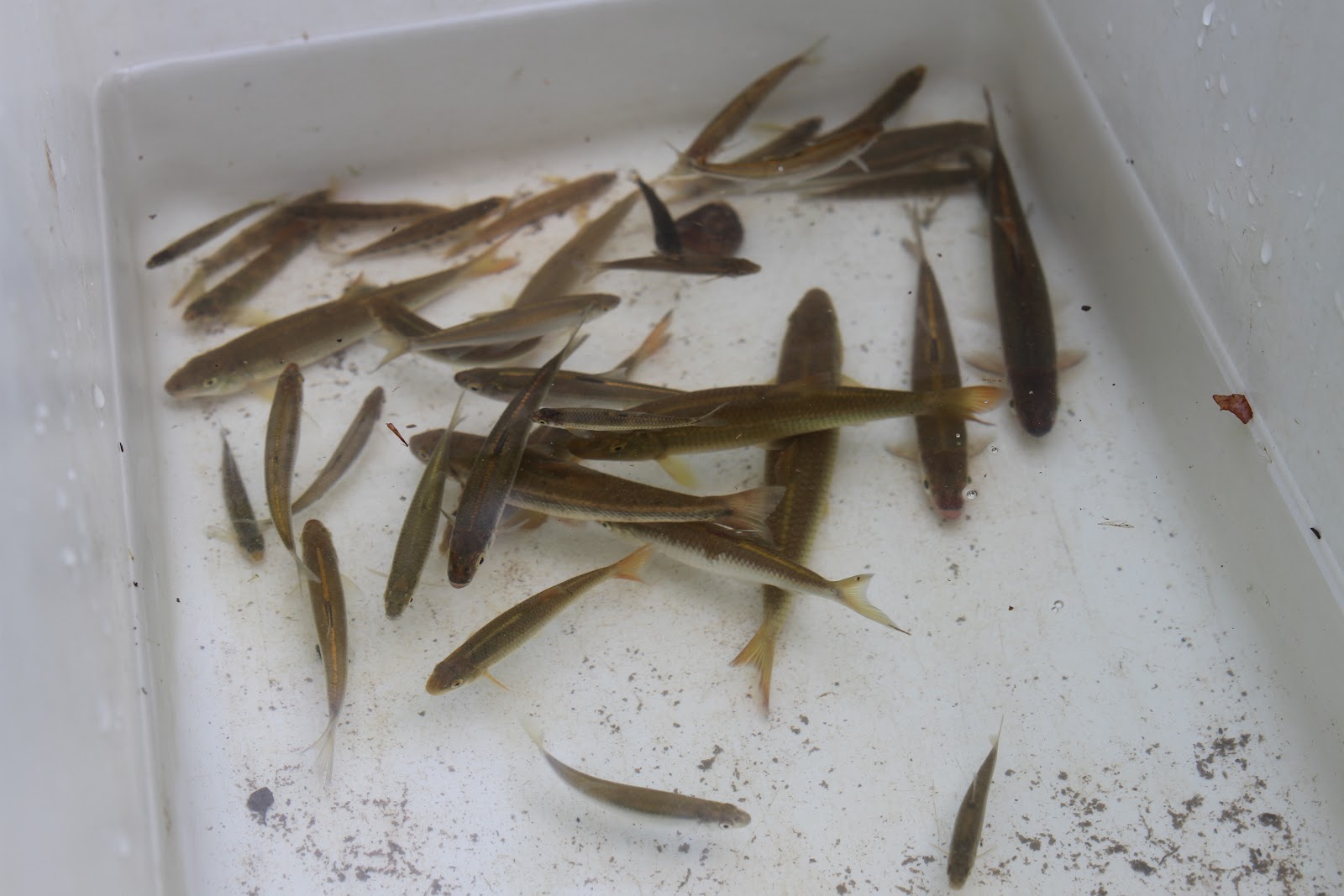
We did not see any other media on our recent outing on the Roanoke River where I hoped to accomplish two things – profile Bob Jenkins the man who wrote the book on the freshwater fishes of Virginia – and to show you video of what he’s written about – not the bass and sunfish you already know about, but the beautiful denizens of the river bottom most people have never seen nor heard of.

I’d say we did both. 

We met Jenkins and a team led by Dr. Steve Powers at Green Hill Park in Roanoke County. Jenkins had recently retired from RC and Powers is the person who picked up where Bob left off.  The group used large seins or nets to capture dozens of specimens, among them many darter species that are among the most beautiful fish in the river.

Roanoke Darter

Powers and the team chase small fish into the net.


We also talked about some of the other “keystone” species, like chubs, which build nests out of pebbles, that other species depend upon for reproduction. 

Fantail darter
Jenkins, a noted character who loves Pink Floyd (and other music once described as counter culture) as much as the river, was as colorful as advertised and had no trouble sharing a lifetime of river research on camera.  Don’t worry we edited out the parts where he was a bit too scientific!  (He is, after all, a scientist)

I admit it – I’m a fish geek.  I find this stuff fascinating.  I hope in this story you will see some reason for your own fascination.  Perhaps you will be – as many are – amazed at the number of and variety of fish that call the Roanoke River home.

Stonefly nymph
If nothing else – maybe you’ll look at the river that flows through the heart of our valley a little differently next time you cross over it in your car or while you’re  walking along the greenway. 

By the way – it’s in better shape than you might think and represents a great resource for all of us.


Thanks to Dr. Steve Powers for the photos of the darters.

Tuesday, May 15, 2012

After Jack

For the second segment in a row we have focused on talented local musical acts trying to accomplish the same thing as the American Idol contestants.  How hard is it to make it?

Fox Photographer Curt Schruth takes some video of After Jack.


Mary Allison
After Jack is an interesting band to say the least.  Three young women -- all talented actresses, musicians and vocalists who play a twangy, bluegrass or "roots" oriented sound that ranges from Lady Gaga to their own song, Bless Your Heart.

They play multiple instruments and harmonize beautifully.

All three live in the same old farmhouse out in the country.  What a hoot it was to record our segment as they practiced on their front porch.


Rachel Blankenship
In the previous segment I asked local rockers Madrone how hard they were willing to work to make it.  The four young men said they would work as hard as they could, but have no delusions about being the next Metallica.

I had hoped they would say they wouldn't quit till they had a wall full of gold records, but that wasn't their answer.

Ditto for After Jack.

"We work for the privilege to continue working," said Emily Rose Tucker.


"We work for the privilege to continue working."

In other words we hope to be good enough to get another gig.  And then another.  And another.

Like Madrone, the members of After Jack want to build a following, get better every performance and see "where it takes us."

You have to admire that.  Last night (May 14) I had the honor of speaking to Roanoke's B'nai B'rith award winners -- essentially the true who's who among Roanoke Valley High School seniors.

I shared with them the thought that they needed to figure out what they loved and where they excelled and to pursue that.  I asked them, "How many people who work in cubicles, 'work for the privilege to continue working?'"

Look, we all have to work for a living, and few people with responsibilities can pack up and hit the road chasing a dream.  But if you have the talent and the passion.  If you know that's who you are, why not?

Emily Rose Tucker, Rachel Blankenship and Mary Allison, whom I've seen perform in the Jack Tale Players and in musical productions at Ferrum College seem to me to have the presence and talent to entertain the masses.  They have only been After Jack for nine months.

After a lifetime of performing each said they felt a certain success with this band they had not felt before.

I hope one day we see them on the Grand Ole Opry or hear them on the radio or interview them when they make a gold record.

But for now, they are just hoping to be good enough to "keep on working."

Tuesday, May 1, 2012

Madrone: Rockers Trying to Make It.

During May, I am talking to two bands who are trying to "make it" in show business.  This blog is dedicated to the Roanoke based rock band Madrone.  The segment on May 15th will focus on the all-female band After Jack.

John "JD" Sutphin
I don't have a musical bone in my body, but I have always appreciated those who do.  Like many of you I watch American Idol and I see an enormous amount of talent.  When it's down to the final groupings, it's really hard to say who should stay and who should go.

But then even the winners don't often stick around for long.  Why?  Why do some people make it and some not?

Before American Idol and the other shows that have attempted to capitalize on the concept, people had to make it the the old fashioned way.
They had to earn their way to the top.  I thought it would be interesting to look at two local bands who have created a following to see what it takes.

Guitars stashed near the Tide.
I keep thinking of the Frank Zappa song, Joe's Garage, that we played on the college radio station: 

It wasn't very large
There was just enough room to cram the drums
In the corner over by the Dodge
It was a fifty-four
With a mashed up door
And à cheesy little amp
With a sign on the front said
"Fender Champ"
And a second-hand guitar
It was a Stratocaster with a whammy bar


Local rockers Madrone, made up of JD Sutphin, Joey Coleman, Blaine Davis and Tanner Dogan seemed the perfect people to ask.  They have had a top 50 hit on the rock charts.  (Daybreak) They play 150 gigs a year and they have opened for some bands that have already made it to the next tier.

They don't play in Joe's garage.  They play in JD's basement.  They have cool stuff all around their half of the cellar.  The other half has washing machines and lawnmowers.  They are living the dream.

Blaine
We could jam in Joe's Garage
His mama was screamin'
His dad was mad
We was playin' the same old song
In the afternoon 'n' sometimes we would
Play it all night long
It was all we knew, 'n' easy too
So we wouldn't get it wrong


Madrone let me sit in on a practice session, and they answered my questions with enthusiasm.  They are as anxious to tell their story as they are for their next gig.  They love what they are doing.  Each band member said plainly that he would rather play music than do anything else.

Joey on drums
I push on the "making it" part.  How hard are you willing to work?  How long are you willing to be a short order cook by day so you can play at night?  (Blaine) Or in Joey's case -- how long are you willing to paint explosives trucks on 3rd shift so you can replace sleep with the drums?

For now -- they are all willing to do whatever it takes.  I expected that.  What I didn't expect was the definition of "making it."

While JD says it would be "awesome" to tour in the band's own bus, "pulling an suv," for the most part the consensus was that they would be happy to always be improving.  To hone their sound so that it is in fact their sound.  You hear the music and you say, "Oh, that's Madrone."

And they are working hard, in JD's basement to do just that.  "We'll never be Metallica" I heard during the interviews.

Well, maybe not.  I'm not qualified to say who has what talent.  But I think it's an interesting question, and in the meantime Madrone is on a roll to who knows where.

Here's a link to Madrone on Reverbnation:   http://www.reverbnation.com/madrone
The My Space Page:   http://www.myspace.com/madrone


Tuesday, April 17, 2012

Wytheville UFO's 25 Years Later

1987 UFO photo by Danny Gordon
It's been a long time since I thought about the UFO sightings in Wytheville.  They happened over a six month period starting back in 1987.  At the time I had been the news anchor at WSLS for just a few months, but I also enjoyed reporting from the field.

So when the call came in to the newsroom that people were seeing something in the sky over Wytheville -- and that some of the witnesses were credible lawmen -- off I went.

Danny Gordon in early 1990's
The story had, as we say in the news business, "legs."  Which means it continued from day to day with new developments and angles.  It died down after a while, and then came back to life a few years later when NBC's Unsolved Mysteries ran a lengthy segment in the early 90's.

Another of Gordon's images
That was the last I thought of it, until a documentary producer named Sean Kotz e-mailed me a couple of weeks ago asking if I would agree to be interviewed.  His company is Horsearcher Productions, and he wanted my media perspective on the sightings.  What was it like to cover a UFO sighting?  How did we approach the story?  Were we looking for answers as to what people were seeing, or were the people themselves the story?

I agreed to the interview and then asked Sean if he would allow me to do a segment on him and his project.  I wanted to know why he was revisiting the story.  What if anything had been learned in 25 years?  Did people still believe they had seen something?  What impact did the sightings have on people's lives?  What did he plan to talk about for the entire length of a documentary?

 So, in a rare piece of media history, Sean interviewed me on camera, and then I turned around and interviewed him.

Sean and I interviewing in my study.

He agree to be interviewed for John Carlin's Virginia. So, in a rare piece of media history, Sean interviewed me on camera, and then I turned around and interviewed him.  It's certainly a first in my career.

Sean then sent me this clip he is using to raise money for his documentary.  It shows Wytheville radio newsman Danny Gordon -- the epicenter of the original story talking about what he remembers and how it impacted his life from people breaking into his home, to a nervous breakdown.

Here is a link to his fundraising page:  http://www.indiegogo.com/strangecountry  And if you are wondering what he's uncovered so far, you might want to check this out.
http://www.horsearcherproductions.com/wythevilleufo.html

Sean hopes to have the documentary ready by the actual anniversary date in early October.  He will make it available on DVDs, and he's hoping to get some notice at the fall's film festivals.

As to what he's found about the UFO's and the impact some 25 years later...  Some of that will be shown on my segment on the FOX 21/27 10 p.m. News.  The rest he's holding close to the vest. to be revealed in his documentary.

Then and now, the Wytheville UFO's are a fascinating story.

Tuesday, April 3, 2012

Paint Bank Trout Hatchery

Downtown Paint Bank
Here is a link to the story that aired on FOX 21/27:  http://www.fox2127.com/category/220112/john-carlins-virginia
 
This is the time of year I always think of fishing for trout.  And I often think of how my buddies always gloat when they catch a brown trout, as if it’s a bigger prize than a brook trout or a rainbow.

Let’s face it,  for the most part trout fishing in Virginia is 95-percent “put and take.”  For non-anglers that means, the state stocks the fish in the creeks and rivers, and dozens of people come in not far behind them and catch the fish.

Nobody is using any different technique to catch a brown trout.  They are fishing for trout.  Period.

Brown Trout
So imagine my surprise as we toured the Paint Bank Trout Hatchery for the latest edition of John Carlin’s Virginia and Supervisor Brian Beers essentially conformed what my buddies have said about browns.  And then he proved it.

We walked beside the raceways where thousands of trout swarmed to the food pellets he threw in the water.

Beers with a net full of trout.
As we approached the rainbows they came swimming toward us in anticipation of dinner.  The brookies did the same.  But not the browns.

As we approached the pool full of brown trout, they swam in the opposite direction!

“It’s a lot harder to domesticate browns,” mused Beers.

So there you go.  If you catch a brown, go ahead and brag.

By the way, the hatchery is open to the public.  Tours are available during hours the hatchery is open.  And while you are there, you owe it to yourself to stop at the Swinging BridgeRestaurant.  It’s a great way to spend a day not too far from Roanoke.  Just take route 311 until you get there.
Happy John


Beers with a Rainbow
Browns from above


Tuesday, March 20, 2012

Twisted Sticks

Al Stewart and one of his creations.
You don't typically wake up in the morning thinking you want or even need a carved walking stick.  At least most people don't.  Then you see Al Stewart's work, and you wonder how you can live without one.

Al seems to be about as unlikely an artist as you might meet.  At least on the surface.  Remember I've worked in ad agencies and in television where creative people have that certain look.  Call it agency chic.

Not Al.

Al is a retired maintenance manager.  He lives on in a regular house in a regular, semi-rural neighborhood and he and his wife attend craft shows.

But then he takes out a knife or a dremel or some other tool and starts carving and you start thinking about lessons learned from book covers and judging.

This stick has a rare, crossing vine mark
Al looks at a piece of root at the end of a stick and sees an elephant, or a fish, or a giraffe.

He pointed out all the options to me as we shot footage for the TV story on Fox.  All I saw was a root on the end of the stick.

It's not all about money


I have to mention that I'm amazed at the pattern that's developing in my John Carlin's Virginia interviewees.  They are not motivated by money.  They just want to keep doing what they are doing.

Raw sticks with vine marks.
Al is afraid to sell his works on Ebay, where he cold get more money, because he's concerned he won't be able to find enough sticks.  What would he do with his time, should he run out?

Like others I've interviewed of late, it's more important to be able to keep doing what they are doing, than to have more money.  Whether it's Wayne Henderson who sells a guitar for $5,000 that he could sell for $40,000,  Nancy Weekly, who works 12 hours on a bracelet and could get $200 for it, but sells it for $80 -- about minimum wage, or Al who gets less than $100 (typically though some go for much more) for his rare creations -- it's the same story every time.

Videographer Curt Schruth shoots video in Al's garage.
In each case, it's clear that the product he or she is producing is a part of them.  They couldn't live as happily without making guitars, jewelry or walking sticks.

That's probably true for many people.  And I'm betting there are many more who spend their entire lives searching for that single passion that, like the vines on Al's saplings, can entwine itself around one's life, needs, personality -- whatever.

So here's to people with a talent, a passion, and the sense to recognize its true value.

If you would like to contact Al, e-mail me at Carlinagency@gmail.com.