The rest of the story...

Here's where I tell you all the stuff that wouldn't fit in a 2-minute TV story.

Tuesday, March 6, 2012

Mission: Jewelry

Fox Photographer Curt Schruth takes some video of Nancy.
Jewelry is not exactly my thing.  I don't wear a fancy watch, and aside from cuff links and a very basic wedding band, there is nary a bit of bling in my being.  But a couple of weeks ago when my wife Mary and I went to lunch at 2nd Helpings, I met Nancy Weekly, whose creations are well beyond bling.

Nancy was demonstrating how she makes the jewelry that's for sale in the cases.  A significant percentage of each sale goes to help the Rescue Mission.

It was intriguing to see how she took pieces of wire and created elaborate chains, or  transformed pieces of rock into shimmering mini-sculptures, which she then wrapped in gold or silver to create original, wearable pieces of art.

The daily report of good from the Mission's website.
And then there's the part of her that is called to ministry.  She makes jewelry not only to generate  a small amount of money to augment her retirement income, but because she believes in the value of the Roanoke Rescue Mission.

There wasn't a lot of time in the TV story to get into how Nancy learned about how to make the jewelry and how she became involved in the Mission, so I'll take a moment here.

Nancy was working with a local women's group looking for activities and tours.  She took a group to the Rescue Mission and she was hooked.  Now, she not only sells her jewelry exclusively for the Mission, but she also teaches jewelry making to people at shelter who need a distraction, a vocation or both.

18" Genuine Stone sets -- Normally $45, now $25.
She asked me to pass along the fact that during the months of March and April, the mission has a special offer on the necklace and earring sets in the photo.  They are half price, and a value even at full price.

You owe it to yourself to take a trip to 2nd Helpings, have lunch, check out the art on the walls -- and in the jewelry case.

Like I said I don't know much about jewelry, but I do know talent when I see it.


Monday, February 20, 2012

Unbridled Change: Horses Helping People

Bonding with Coco
This is one of those times when it's frustrating to be a television reporter, where all stories are measured in time.   To be clear, my segments on the Fox Ten o'clock News are longer than most, but this story, of how horses help people with emotional problems, required even more time to tell properly.

Thankfully, there is the internet with what we call a, "bottomless news hole."  That means I can write as much as I want and never run out of space.  You may run out of interest, but I will never reach the bottom of the page.

Michelle Holling-Brooks and crew.
I hope the meaning in this story comes through on the air, but here's my attempt to explain the thing about horses as opposed to say, a human therapist or other problem solving approaches to therapy.

Michelle Holling-Brooks was very patient with me as I asked her how horses help people.  Since I didn't feel I needed any help in particular, but was about to carry out the exercise that her clients go through, I wanted to know why the horse made a difference.

She had made a triangle in the middle of the indoor riding ring.  My job was to get a pony named Coco to go stand in the middle of the triangle.  I could use anything nearby to get Coco to do this.
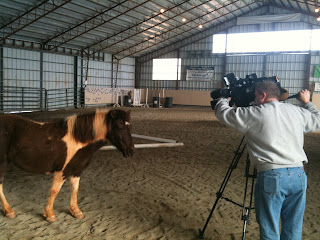
Coco poses for Fox Photographer Curt Schruth
In order to do what Michelle wanted, I  needed to form a relationship with the horse -- to try different approaches until something worked.  And here is the key, horses are not like dogs.  You want a dog to come, you say "come." You clap your hands, act excited, get on your hands and knees and the dog will come to you.  A horse will think you are nuts.

Horses live in the moment.  If you do the right thing, at the right moment, you can persuade a horse to do what you want.  But here's something else about horses, if you don't REALLY want it -- if you are not REALLY paying attention to that horse, it will not acknowledge your request.  It will put its head down and pretend to be eating.  Trust me.  Horses know what you're thinking.  I learned this.

Here's the human part.  Many of Michelle's clients have a hard time forming relationships with people.  They might be an abused woman, a victim of child abuse, or a vet suffering from post traumatic stress disorder.  They need to learn to form relationships.  Unlike humans, the horse will not judge their character -- only their sincerity.  And if Coco is any proof, horses know when a person is being sincere.

I asked Michelle on camera to give me the best example of how a horse helped someone.  The answer was too long for the TV story -- but not the bottomless news hole.

"We had a client who was a girl in a residential treatment home.  She didn’t believe anyone wanted her.  She didn’t think she deserved love. At times people had to restrain her.  A family wanted to adopt her, but she was sabotaging adoption," Michelle told me.


 "And she at that moment collapsed into the horse, put her arms around it and just started sobbing and crying....

Frustration set in as the girl tried and failed to get the horse to do what she wanted.  She ranted and circled the horse at a distance, yelling at it.  The horse seemed to understand that she was angry at the world not with him.  The horse moved closer until he was chest to chest with the girl.

Michelle picks the story up from there: "And she at that moment collapsed into the horse, put her arms around it and just started sobbing and crying.  And they stood that way for a while until eventually her legs buckled and he just lowered her to the ground, and they stood there at the ground for what seemed like forever, and the (other) therapist was like, 'oh I’m going in…' and I said, 'no, just wait the horse is doing his job.'  After a few minutes, the horse picked his head back up, her arms were still linked over the horses head, so it picked her up.  And she was talking to the horse…. Her arms fell gently to her side and she looked over at us and said, 'He didn’t leave.  No matter what I did he didn’t leave me.'   

The girl was adopted and went on to college.  There were certainly other forces guiding her success, but horse therapy was one of them.

Red was another pony. 
Back to Coco and me.  I finally figured out how to get Coco to go to the triangle.  (see the news story for details)  But one time, Coco suddenly walked away.  Michelle asked me, "Did you just have a change of thought?  Maybe wondering what to do next for your story?  In fact, I had.  "Coco knew," she said.  "You stopped thinking about Coco, so she left."

I challenged her.  I said it was a pure coincidence.  "No," Michelle patiently explained.  "We do this all day every day.  I see it all the time.  That is the magic of horses."


An exterior shot of the heated indoor ring outside Boones Mill.

If you want to learn more about Unbridled Change, I encourage you to look at their website.  Michelle, as the founder and executive director is still a volunteer.  There are some paid counselors and several other volunteers, but like most not-for-profits, they need donations to survive.  Please give them a look and consideration when you are writing check to charity.


Tuesday, February 7, 2012

Mokuchi Woodworking with Yann Giguere

Yann uses his foot to steady his work.
When you first see Yann Giguere, you notice his long beard.  Then he speaks and you notice his French Canadian accent.  You think, "Ok, this is not the typical guy you see at a Salem ball game."  And he's not.

Then, when you see what he can do with piece of wood, you realize he's not like other handymen either.

As I detailed in the TV story, where you can actually see what Yann does, as he does it, Yann uses uber sharp blades to slice through the fibers, creating a smoothness that cannot be had any other way.

When a friend first told me about Yann, I asked what made him so different.  The best my friend could offer was to say, "He doesn't use any sandpaper."

Well, sure enough, he doesn't.   But that's just the tip of the iceberg.  Yann has nothing against sandpaper.  It's just that he doesn't need it.  Why would you sand something that is already so smooth it glistens?

 Yann is to other woodworkers, what Yoga is to basketball.

And there's much more.  Yann is to other woodworkers, what Yoga is to basketball.  Both Yoga and hoops are exercise, but they work the body very differently.  He works with an inner calm.  The Chi in his word, Mokuchi comes through in a big way.
Fox photographer Curt Schruth shoots video of Yann

He sits on his work instead of using clamps.  Or he might put a stocking foot on the wood to hold it in place.  The sharpening of his tools is a ritual in itself.  He squats like a baseball catcher, rubbing hardened Japanese steel on stones with fine grit.  It takes hours and hours -- and dedication beyond any suburban existence to accomplish this literal oneness with the project.

It's funny.  Because Yann understands how it looked to me and to others who have seen him do his thing.  But he's very upfront about things like deadlines, and the need to make money and make the customer happy. 


Shavings from Yann's plane
"It’s always an exercise in balance.  How much time do I have.  How much time to I need to spend for this tool vs. that tool? What is the deadline on this project?" 

Sounds more like the business people I deal with every day.   Hurried.  Rushed.  Yann is none of those.  You get the impression that he would never sacrifice anything just to meet someone else's deadlines.

He became philosophical during our on-camera interview.  (Or maybe he always is, and I just looked past it for while.)

Simple wooden blocks hold  the sharp blades
"For some reason people often think this work is meditation and yess, it can be, but a meditation doesn’t mean, you know slooow... looking off into the clouds," he said.  Then he paused and his eyes showed he had arrived at  an aha moment.  He looked at me and said, "It's focus. Yes, focus."

 I doubt I'll ever feel the inner peace that seems to dominate Yann's existence.  Too much hurry in my life.  I'm betting that's true for most of us.

But it sure is something to watch him use those blades to create his masterpieces.  I think it's a heck of a story. 


Monday, January 16, 2012

Labeling Tomatoes

Label Collector Charles Woods


I told a few people that my next story would be about a local man who collects labels from tomato cans.  Most of those people looked perplexed.  Their eyes had that sort of, "Slow news day?" look.

Not at all.

I love this story.  It's colorful both in terms of the personality of the collector and the items he collects.  It's rare, if not unique, and it gives us a look at a time and place that we might never have thought about, if not for Charlie Woods and his 10,000 labels.

That's what I've always wanted John Carlin's Virginia to be.  We hear enough about high tech entrepreneurs.  We hear too much about Hollywood's latest darlings and scandals.  There's too much about the latest car accidents and this week -- the terrible sinking of a cruise ship.  Why not take a few minutes to see what one man has turned into a passion?
 
The artwork is beautiful.
There are a couple of story lines here.  Charlie Woods collects canning labels from canneries that were once located, "up every valley and holler around here..."  That's unusual.  Who does that?  Not many people that's for sure.  In my mind, that's plenty of reason to shine a light on this.

In addition, Charlie knows the personal stories behind many of these labels.  Like the one about a soldier who wrote home that the tomatoes he ate overseas came from the local cannery and made him think of home.
A Boones Mill area cannery
When Charlie talks about this cannery or that cannery in Bedford, Franklin or Botetourt Counties, he takes you along for a ride in history.  He knows where the canneries were, he knows how they worked, how many people they employed, and how the government slowly shut them down -- mostly because they didn't meet standards of cleanliness.  He can tell you the date of another label because there is or isn't an "s" on the Boone in Boones Mill.  The "s" wasn't added, according to Woods, until 1931. 


Note spelling of Cahays vs."Cahas" and no "s" on Boones Mill.


A cannery near Goode, Va.
So on the surface we have a story about labels.  But really, it's an interesting tour of the history of our rural counties -- which we would not have -- if people like Charlie didn't have such interesting collections.

Tuesday, January 3, 2012

A Conflicted Musician

Jeff Midkiff is a really good mandolin player. Really good. Virtuoso for sure.

Jeff Midkiff is also a really good clarinetist. Same level. Classically trained. Master's degree.

When was the last time you saw a band, orchestra, ensemble, trio or duo featuring both the clarinet and the mandolin?

Catch my drift?

Musically they go together like a Porsche at a monster truck show.

Jeff's conflict became my conflict as a writer and reporter.

Jeff is local. Easy to write into the story. "Local boy does good."

But at what? Playing music?

That's an understatement.


At the clarinet? He's good enough to do a whole story just on that. But then the mandolin is his true love. Would it be fair to do a report that included only one? Would his followers think I had missed half the story?

Jeff with mandolin he bought as a teen.
We writers like a simple story line. "Local boy gets mandolin from neighbor at age 7 and goes on to become world's best."

But no. Jeff has this musical schizophrenia going on. Or he did -- until the last few years when he began to combine the freedom of the mandolin with the strict discipline and daily effort that marks a true clarinetist.

Thankfully, he recently wrote a mandolin concerto for the Roanoke Symphony Orchestra. That angle gives me a way to get into all this great background -- and to structure the story so you can hear him play both of his instruments.

The fact is that, conflicted or not, Jeff is a local treasure. He makes it look so simple, while representing at the same time how hard it is to be a truly world class musician. And he does it right here in Roanoke -- where by the way he teaches music in the Roanoke School system.

I hope you enjoy the story as much as I enjoyed meeting Jeff and listening to him play his music. It really is a treat.

By the way, he also plays the fiddle.  But I just couldn't go there. 

To hear more of his work, learn about his CD or more background on his career go to his website: Jeffmidkiff.com.

Tuesday, December 20, 2011

Sled Dogs in Virginia


One of the Huskies that pulled us on the New River Trail.
The first time you see it, you're torn between thinking it's beautiful and thinking it's funny.  Sled dogs pulling a person -- on a scooter.

The dogs are beautiful and athletic.  They lean into the harness as if it was the only thing that mattered.  Their blue eyes and contrasting white and silver fur shimmering in the sun.

Jenny, Tina, Sam and Wayne show me the "real" sleds.
And then there's the person in the back, looking like, well, not what you'd expect those gorgeous huskies to be pulling -- a two wheeled contraption without pedals that looks like it could come from Toys R Us.

On the other hand the people are having a blast, and so are their dogs.  

As a dog lover, I appreciate the people in this story.  Jenny and Sam Akers, Tina Gibson and Wayne Grim.  To a certain extent they backed into their new pastime.  Forgive the pun, but when you look at the back story it's kinda like the tail is wagging the dog.

I've got to believe most sled dog enthusiasts get into the sport saying something like, "Hey that looks like a fun winter sport, I think I'll get some dogs and give it a try."

Fair enough?

These people kinda went, "Hmmm now that I have these huskies, what am I supposed to do to keep them from chewing up the couch?"

Wayne let me try his rig.
You'll understand if hitching them to a sled wasn't the first thing that came to mind.  After all Virginia is not exactly the land of the mushers. 

Their interest originates with Siberian Husky Assist, which helps Huskies find "forever homes" in the area between Roanoke and Knoxville, TN.    Even Jenny Akers, who may be the biggest Husky lover in the group, told me during our interview, "Huskies aren't for everyone.  Open the door and they'll take off -- might never come back.  If a thief breaks into the house the Husky will help them pack."  In other words, the breed is not for everyone.


The Siberian Husky Assist website asks that you watch this video: 


Google the word Husky and you'll get ample warning that you may be biting off more than you can chew.  (Pun #2 -- sorry.)  They shed.  They have wolf-like tendencies.  They are big dogs, which often don't do well in small houses.  You get the point(s).


But these folks have figured it out.  They've adopted one dog and then another and another.  They meet at the nearly perfect New River Trail and they let their happy dogs burn off all that energy.  And the people thrive too.

They slow it down in the summer when the dogs can over heat.  In the winter they let the dogs pull the scooters and the sleds on wheels.  When it actually snows, it's like heaven for the dogs and their mushers.
Tina and one of her dogs.


Group shot.  Thanks for an interesting story.

I encourage you to take a look at the Siberian Husky Assist website.
Jenny Akers can be reached via e-mail at bluenorthernwind@gmail.com  Marcia Horne, president of the rescue is at siberianhuskyrescue@yahoo.com


Tuesday, December 6, 2011

Black Pot Chicken


Black Pot Chicken

Like many people I had waited in line at the Blue Ridge Folklife Festival for a taste of Black Pot Chicken.  And like many, I finally tired of waiting and walked away.  This year I decided to get to the bottom of it.  Or at least try.

As I interviewed people for this story as they stood in line, it was a common refrain.  Like a marathon, a mountain climb or Black Friday at the electronics store,  people were determined to get there.

Success in this line means literally tasting victory.

In the television story you can see the sizzle of the chicken cooked in peanut oil, and almost smell the aroma coming from the golden brown legs, thighs and breasts, as the Patrick County Ruritans go through their familiar paces.

To re-cap:  The Patrick County crew was at a national conference in Philadelphia in 1976, when some kindly and elderly fellow Ruritans gave them a copy of their own secret recipe.  Only one man, Phil Plaster, was given the secret, and to this day, only Phil has it.  It’s in his head and his safe deposit box.  His wife and his will have instructions about who gets it next.

The local guys came home and tried it at a July 4th celebration and knew they had a winner.  They signed up for a spot at the Blue Ridge Folklife Festival and they’ve been there ever since.  And so have the lines of people.

The guys I interviewed -- cook Will Walker, chicken batterer Ronnie Mabe, and secret holder Phil Plaster seem to love all this.  They grin when they talk about everyone leaving the room while Phil adds the secret ingredients.  They cut-up about Ronnie Mabe outliving Phil just so he can be next to know.  Will Walker, who is physically closer to the line of people by virtue of being the cook, has had ample opportunity to practice his answer to the inevitable question, “What makes this so good?” 

“I just do the cooking,” he dead pans.

Once again the great part about this job, and this segment, is that the people are so real.  These guys just enjoy what they do.  Go to a festival and sell secret chicken to appreciative festival goers.